They are connected through gene expression: your weight, diet, activity, sleep, and stress leave chemical marks on your DNA that change how your genes behave, and those marks influence your metabolism in return. Epigenetics is the science of those marks, and unlike your genes themselves, they can change.
Most people believe their DNA is a fixed sentence. In truth, your genes are more like a piano. The keys never change, but what gets played, how loudly, and how often changes throughout your life. That is what epigenetics studies, and it is why two people with similar genes can end up with very different health.
For anyone who has ever said “it is just my genetics”, this article is the hopeful, honest answer. Your inheritance matters. What you do with it matters more than you may think!
What Does Genes vs Lifestyle Really Mean for Your Body?
Your genes set tendencies, and your lifestyle decides how strongly many of those tendencies are expressed. The switch between them is epigenetic: chemical tags, chiefly DNA methylation, that turn the volume of individual genes up or down.
Think of DNA methylation as small dimmer switches attached to your genes. Eat well, move often, sleep enough, and the dimmers tend to settle in healthier positions. Years of stress, poor sleep, and excess weight nudge them the other way. The genes never change. Their settings do.
This is why the old genes vs lifestyle debate misses the point. Identical twins are born with the same DNA, yet often drift apart in health as their lives diverge, because their epigenetic settings diverge. Your genome is the hand you were dealt. Epigenetics is how you play it.
How Are Epigenetics and Weight Loss Linked in Research?
Excess weight shifts epigenetic marks in ways linked to faster biological ageing, while weight loss and lifestyle change are associated with healthier patterns. Your body weight is not just something your genes influence. It actively writes back.
The numbers are quietly remarkable. A peer-reviewed systematic review and meta-analysis pooling 61 studies of DNA methylation age found that each additional BMI unit was associated with roughly 0.06 to 0.07 years of added methylation age, a few weeks of extra biological age per point.
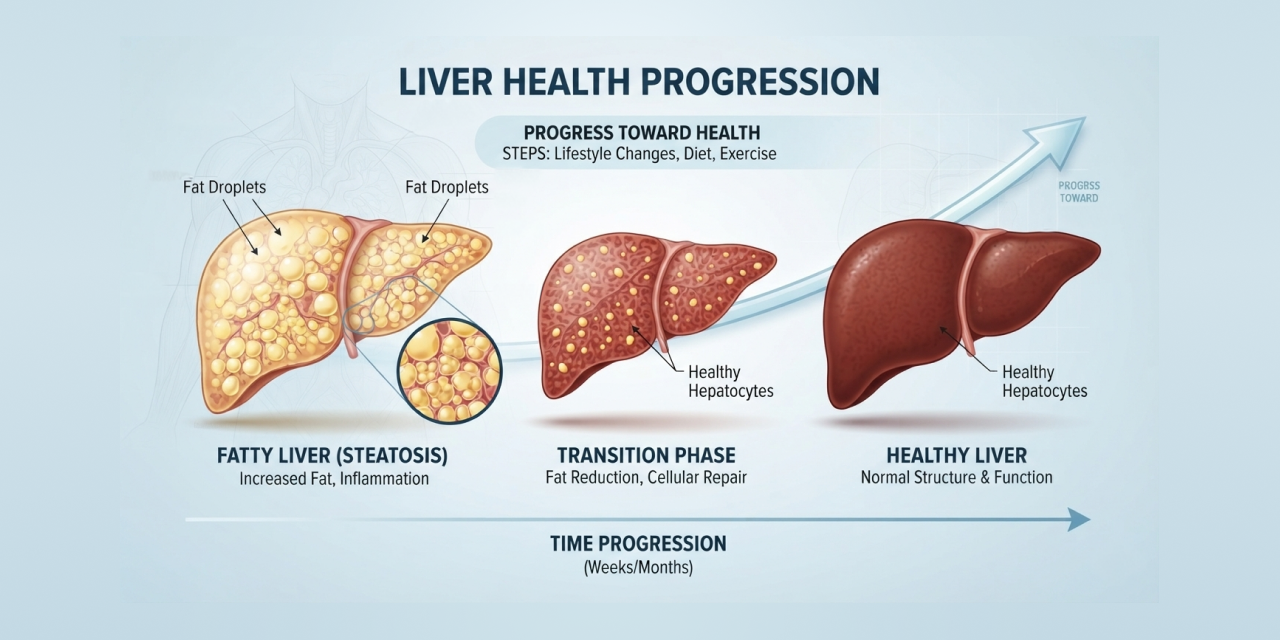
The effect appears strongest where it matters most for this series: a landmark study by Horvath and colleagues, published in the Proceedings of the National Academy of Sciences in 2014 and analysing DNA methylation in human blood, liver, muscle, and fat tissue, found that obesity was associated with accelerated epigenetic ageing of the liver by around 3.3 years for every 10 BMI units.
Carrying significant extra weight does not just sit on the body. At the level of gene regulation, research associates it with faster ageing of your most metabolically important organ. That is the deep link between epigenetics and weight loss, and it is also the motivation: marks that respond to lifestyle are marks you can work with.
What Is a Biological Age Test Built on DNA Methylation?
It is a test that estimates how old your body seems, rather than how old your birth certificate says you are. By reading DNA methylation patterns at specific sites, so-called epigenetic clocks produce a biological age that can sit years above or below your calendar age.
The concept is simple even if the science is sophisticated. Researchers identified sites on the genome where methylation changes predictably with age, then trained algorithms, the epigenetic clocks, to read them. A biological age test compares your pattern against those expectations. Come out “older” than your years and it suggests your lifestyle and health may be accelerating wear. Come out “younger” and your settings look better than average for your age.
Here is the difference at a glance:
| Standard DNA test | Biological age test (epigenetic) | |
| What it reads | Your gene sequence | The methylation marks on your genes |
| Does it change? | Fixed for life | Changes with lifestyle, weight, and age |
| What it tells you | Inherited tendencies | How your living is affecting your biology now |
| Retest value | None, result is static | High, changes can be tracked over time |
That last row is the important one. A fixed result informs you once. A changeable result gives you something to aim at.
| Curious how old your body really is? One simple test starts the answer. Book a consultation and let us map your biology, not just your weight. All consultations are with a qualified clinician, and individual results vary. |
Can You Reverse Biological Age Through Lifestyle Change?
Early evidence says the marks can move in the right direction, though the science is young and we will always tell you so. Pilot trials of diet and lifestyle programs have recorded reductions in measured epigenetic age within weeks, and weight loss studies point the same way:
- The most striking result so far: in an 8-week randomised controlled pilot trial of 43 healthy men, published in the peer-reviewed journal Aging in 2021, a program of diet, sleep, exercise, and stress guidance left the treatment group testing 3.23 years younger in methylation age than controls.
- Separately, the 18-month CENTRAL randomised controlled trial of 120 adults with abdominal obesity or dyslipidaemia, published in Clinical Epigenetics in 2021, found that participants who achieved weight loss showed attenuated methylation ageing compared with those who did not.
These are early studies, mostly small, and researchers themselves call for larger trials. So can you reverse biological age?
The fairest answer today: the dial appears to move with sustained lifestyle change, the direction is encouraging, and the habits involved are the same ones associated with better health regardless of what any clock shows.
How Does Epigenetic Testing Harley Clinic Offers Fit Your Plan?
As the newest layer of the same philosophy: measure first, then personalise. Epigenetic insight joins your bloodwork, body composition, and liver assessment to complete the picture, showing not just where your health stands today but how fast your biology is travelling.
In practice, it is a simple sample, and the result becomes another number your plan is built around and reviewed against, alongside our wider diagnostics, with every result interpreted by a qualified clinician.
Where it earns its place is motivation and tracking.
Cholesterol and weight can feel abstract. Biological age is personal in a way patients tell us nothing else quite is, though experiences differ from person to person.
Watching it respond to your effort, alongside your bloods and body composition, turns a personalised weight loss plan from instructions into evidence.
| Layer of testing | Question it answers |
| Bloodwork | What is happening in your metabolism right now? |
| Body composition | What is your weight actually made of? |
| Liver scan | How is your central metabolic organ coping? |
| Epigenetic testing | How fast is your biology ageing, and is it responding? |
Why choose epigenetic testing UK patients can actually use?
Epigenetic testing UK consumers can buy online usually arrives as a report and nothing more. In a clinical setting, the result is read alongside your bloods, your composition, and your history, then turned into action.
- Context, not just data. Your result is interpreted with your full health picture by qualified clinicians.
- A plan attached. The number feeds a programme, with nutrition and exercise support built around it.
- Honest expectations. We treat biological age as a compass for your personalised weight loss plan, not a verdict, because the science is young.
- Tracking over time. Retesting shows direction of travel, which is what actually matters.
Ready for Epigenetic Testing Harley Clinic Patients Trust?
You cannot choose your genes. You can influence how they are expressed, and now you can measure it. That is what makes this the natural final layer of understanding your body: not fortune-telling, but feedback. Your biology is listening to how you live.
Learn more about our clinic or speak to the team today.
FAQs
- Is an epigenetic test the same as a DNA ancestry test?
No. Ancestry and standard DNA tests read your gene sequence, which never changes. An epigenetic test reads the chemical marks on top of your genes, which shift with lifestyle, weight, and age. One tells you what you inherited. The other tells you how you are living.
- How is the epigenetics test actually done?
We do it through a saliva sample, taken in minutes. The laboratory reads methylation patterns at specific sites on your DNA and calculates your biological age from them. There is no scanning, no fasting for the epigenetic component, and results are received through an app and additionally can be reviewed with a qualified clinician.
- How reliable is a biological age result?
At DEPH Lab in Harley, our approach is designed to make biological-age assessment more relevant and personalised. Rather than assuming that ageing is identical for everyone, our technology incorporates sex-specific biology, including UmmuAge for women and AlphaAge for men.
The greatest value comes from looking at change over time. Your first saliva test establishes a baseline, while repeat testing can show whether your biological ageing trajectory is moving in a favourable or unfavourable direction.
So, rather than viewing biological age as a fixed number, think of it as a molecular snapshot of your ageing trajectory measured simply from saliva and designed to be tracked over time.
- Can losing weight really change my epigenetic markers?
Early research suggests it may. Trials associate weight loss and lifestyle change with slower methylation ageing, though studies remain small and scientists want larger ones. The encouraging part: the habits involved are linked with better health regardless of what any clock says. Individual results vary.
- How often should I retest my biological age?
Annually, or after a sustained period of lifestyle change, is a sensible rhythm for most people. Methylation patterns shift over months, not days, so testing too frequently mostly measures noise. We time retests around your clinician-led reviews, so every result has context and a next step.